
MUSCULAR CONDITION TESTS FOR SWIMMING
[Adapted from Rushall, B. S., & Graham, K. S. (1993). Muscular condition tests for swimming. NSWIMMING Coaching Science Bulletin, 2(20), 1-13. Kenneth Graham is Head Sport Scientist for the New South Wales Institute of Sport, Olympic Park, Homebush, Australia.]
This document contains descriptions of and protocols for tests that can be used by post-pubertal NSW swimmers to assess the performance of important muscle groups. Some tests are in the formative stage of development. In time, their scientific verification will be completed. All have been adjudged, by a panel of sport scientists and appropriately trained coaches, to have considerable face validity for assessing the type of performance each muscle group has in swimming.
These tests are not appropriate for swimmers who have yet to enter the adolescent growth spurt. The age at which this occurs is: (a) for girls, between 11 and 13 years, and (b) for boys, between 13 and 15 years.
The tests which are recommended are as follows.
Coaches are cautioned when first implementing these tests. Since they usually involve maximum exertions, they could cause injury if attempted without adequate precaution. The following activities should precede any testing.
Rationale
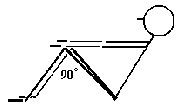
This test is intended to measure the static muscular endurance of the frontal abdominal muscles. Those muscles are important for stabilizing body positions in the horizontal plane about the longitudinal axis in the various strokes.
Description
The athlete is required to hold a particular position until the position is altered significantly or four minutes elapses.
The test position. The athlete should lie on a comfortable, flat surface.
The test protocol. The test is conducted in the following fashion.
Scoring and Evaluation
The time that the position is held is the test "score." It is considered that if the position can be held for four minutes, the swimmer has sufficient strength and muscular endurance to hold an adequate body position in any swimming event.
With each repeated testing, a swimmer should be expected to improve in score. Any regression would indicate specific muscular conditioning of the frontal lower abdominal muscles is warranted (e.g., sit-ups, kip-ups, V-sits, etc.).
Once four minutes is held and is demonstrated on repeated measurements, the conditioning of this particular group of muscles in this form of action only needs to be conducted on a strength/muscular endurance maintenance schedule.
Rationale
This test is intended to measure the static muscular endurance of the lumbar region muscles in the lower back. Those muscles are important for stabilizing body positions in the horizontal plane about the longitudinal axis in the various strokes.
Description
The athlete is required to hold a particular position until the position is altered significantly or four minutes elapses.
The test position. The athlete should lie, face down, on a comfortable, flat surface.

The test protocol. The test is conducted in the following fashion.
Scoring and Evaluation
The time that the position is held is the test "score." It is considered that if the position can be held for four minutes, the swimmer has sufficient strength and muscular endurance to hold an adequate body position in any swimming event.
With each repeated testing, a swimmer should be expected to improve in score. Any regression would indicate specific muscular conditioning of the lower back muscles is warranted (e.g., swan-ups, leg-holds, etc.).
Once four minutes is held and is demonstrated on repeated measurements, the conditioning of this particular group of muscles in this form of action only needs to be conducted on a strength/muscular endurance maintenance schedule.
Rationale
This test is intended to measure the strength potential of the muscles which produce adduction of the upper arm. These muscles are very important in all stroking patterns.
Description
The athlete is required to perform, in a continuous manner, as many wide grip chins as possible.
The test position. The athlete should hang from an overhead bar with the hands spread at a standardized width.
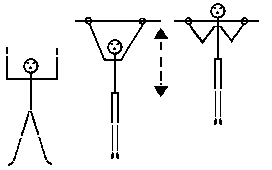
The test protocol. The test is conducted in the following fashion.
Scoring and Evaluation
The number of correctly completed "chins" is the test "score." There is no upper level desirable score. Swimmers should attempt to become as proficient at this exercise and perform it as many times as possible. However, it should be realized that there comes a time when the strength attained by the athlete is of sufficient magnitude that it will accommodate all the demands of the highest level of competitive swimming participation. To improve beyond that point, while being meritorious, may be unnecessary extra work.
Once the swimmer's score becomes relatively constant, that is, it does not improve further despite conscientious efforts to train with resistance exercises to produce improvements, the conditioning of the muscles for this form of action only needs to be conducted on a strength/muscular endurance maintenance schedule.
Rationale
This test is intended to measure the static muscular endurance of the forearms, wrists, and fingers that need to hold hand and lower arm positions in stroking patterns.
Description
The athlete is required to hold a particular position, while supporting a weight, until the position is altered significantly or four minutes elapses. The position of the forearm, wrist, and hand in a pulling pattern is particularly important for establishing force application. The alignment of those anatomical segments must be straight. The ability to maintain that integration will greatly affect the propelling efficiency of a swimmer.
The test position. The athlete should sit on a normal sturdy chair, lean forward and support the back of the upper arms on the knees, and hold both arms and hands horizontally and in a straight line. A weight should be supported in each hand.
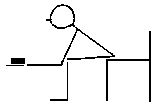
TABLE.1. THE WEIGHT TO BE SUPPORTED IN EACH HAND FOR THE HORIZONTAL ARM HOLD EXERCISE.
=========================================================================
    Body Weight     Exercise Weight     Body Weight     Exercise Weight
_________________________________________________________________________

       40 Kg            2.0 Kg             80 Kg            4.0 Kg
       50 Kg            2.5 Kg             90 Kg            4.5 Kg
       60 Kg            3.0 Kg            100 Kg            5.0 Kg
       70 Kg            3.5 Kg
_________________________________________________________________________
The test protocol. The test is conducted in the following fashion.
Scoring and Evaluation
The time that the position is held is the test "score." It is considered that if the position can be held for four minutes, the swimmer has sufficient strength and muscular endurance to hold an adequate arm-hand position in any swimming event.
With each repeated testing, a swimmer should be expected to improve in score. Any regression would indicate specific muscular conditioning of hand, wrist, and forearm muscles is warranted (e.g., pronated forearm curls, ball squeezing, wrist curls, etc.). If one arm is weaker, exercises should be performed on that arm until it is "balanced" with the other.
Once four minutes is held and is demonstrated on repeated measurements, the conditioning of this particular group of muscles in this form of action only needs to be conducted on a strength/muscular endurance maintenance schedule.
Rationale
The role of the legs varies greatly across the four competitive swimming strokes. Because of the size of leg musculature and the small part they play in total propulsion, they usually are sufficiently strong to effect an adequate kick. With endurance training, leg capacity to meet the demands of competitive swimming can usually be met. However, it is still advisable to assess the "power" of the legs as a general indication of their training "health." The standing long jump is considered to be a satisfactory test for evaluating the condition of the legs. It is more akin to the leg action of dives and turns than any other form of jumping.
Description
The athlete is required to perform five standing long jumps in a particular manner. The average of the three best jumps is to be calculated.
The test position. The athlete should stand feet aligned but apart and be prepared to execute a double-leg take-off accompanied by a double-arm thrust.
It is desirable to conduct this test on a surface that is firm in the take-off area, so that no slipping will occur, but soft in the landing area to avoid injury.
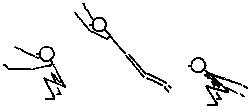
The test protocol. Testing is conducted in the following manner.
Scoring and Evaluation
The two shortest distances recorded in the five trials should be discarded. The remaining three "best" trials should be averaged. That average is the test "score." A minimally acceptable distance is one that exceeds the athlete's height.
With each repeated testing, a swimmer should be expected to improve in score. Any regression or initially unacceptable score would indicate specific muscular conditioning of the legs is warranted (e.g., plyometric depth jumps, bounding, jump-squats, etc.).
Once a distance is consistently recorded, that is, the maximum distance possible seems to have been attained, the conditioning of the leg muscles in this form of action only needs to be conducted on a power maintenance schedule.
Return to Table of Contents for Swimming Science Bulletin.